15.10.08

Sen McCains "My friends, we've got them just where we want them"

"Senator Obama is measuring the drapes, and planning with Speaker Pelosi and Senator Reid to raise taxes, increase spending, take away your right to vote by secret ballot in labor elections, and concede defeat in Iraq. But they forgot to let you decide." - Sen. McCain

"My friends, we’ve got them just where we want them"


ON GOING FACTS:

WASHINGTON - The Republican National Committee is halting presidential ads in Wisconsin and Maine, turning much of its attention to usually Republican states where GOP nominee John McCain shows signs of faltering. (Oct 15 AP)

VARIOUS SOURCES

Worst Trading Period in Living Memory Coming: Manager

Worst Trading Period in Living Memory Coming: Manager
By CNBC.com | 15 Oct 2008 | 09:31 AM ET
Text Size

The winter holidays are unlikely to bring relief to jittery investors as stock markets may fall between 10 and 20 percent within the next four months, Jason Forde, fund manager at Kepler Capital Markets said Wednesday.

"I am very frightened as we go into the festive season, Thanksgiving and Christmas, we will see the worst trading period in living memory," Forde told CNBC.

The sharp downturn would result from the governments, in the U.S. and Europe, taking stakes in banks and forcing them to lend in return for the capital injections the states have promised, instead of scaling back as they do when recessions loom, he said.

"They (governments) are forcing banks to do things in lieu of all the capital injections that they are promising; to do things that from a commercial standpoint do not make sense. For example, going into a recession, banks should be tightening their credit facilities. They should be pulling back, not expanding," Forde said.

As a result, the lending that the banks have been encouraged to do will go sour in the next six to nine months, he said.

Forde also believes that if OPEC does not take the "window of opportunity" at its next meeting in November and agree and instigate supply cuts, oil will head back to $40 a barrel by the third quarter of next year as "global recession goes into its fourth quarter of negative movement."

© 2008 CNBC.com

Predicting 2008 US Presidency based on 2004 Elections

Here are the final national polls for 2004 Election Cycle. Seems to me that CBS/NYT got it right.

Election 2004 final results: Kerry 48.0%, Bush 51.0%, Nader 0.3%, Badnarik 0.3%, Others 0.4%.

Moving on to Oct 15th, 2008,

Current CBS Poll has Sen. Obama up by 14%

If the current trend holds, I predict, 2008 will be a landslide. Every 5% differential equates to 60 Electoral Votes. This is based on 1000 simulations. (http://www.fivethirtyeight.com/)

(EV Sen Obama 361, Sen McCain 176)

As it stands now according to www.intrade.com, which called all 50 states right last time, it is Sen Obama 81.5%, Sen McCain 18.5% chance of winning, as of 12 Noon, Oct 15, 2008.

(EV Sen. Obama 364 Sen. McCain 171)

Pollster Sponsor Dates Kerry Bush Other Not sure N LV/RV
American Res. Grp
Oct 28 - Oct 30 49 48
3 1500 RV
American Res. Grp
Oct 28 - Oct 30 49 48
3 1500 LV
CBS News CBS Oct 28 - Oct 31 46 47 1 6 939 LV
CBS/NYT CBS/NYT Oct 28 - Oct 30 47 50 1 2 824 LV
Gallup USA Today Oct 29 - Oct 31 48 46 1 3 2014 RV
Gallup USA Today Oct 29 - Oct 31 47 49 1 3 1573 LV
Opinion Dynamics Fox News Oct 30 - Oct 31 47 45 1 5 1400 RV
Opinion Dynamics Fox News Oct 30 - Oct 31 48 46 1 5 1200 LV
Greenberg Dem. Corps Oct 26 - Oct 28 49 46 2 2 1502 LV
Harris
Oct 29 - Oct 31 45 49 3 3 1092 LV
Los Angeles Times LAT Oct 21 - Oct 24 47 47 1 5 1698 RV
Los Angeles Times LAT Oct 21 - Oct 24 48 48 1 3 881 LV
Marist Coll.
Oct 31 - Oct 31 48 48
4 1167 RV
Marist Coll.
Oct 31 - Oct 31 49 48
3 987 LV

NBC/WSJ Oct 29 - Oct 31 47 48 3 2 1014 LV
PSRAI Newsweek Oct 27 - Oct 29 44 48 1 7 1005 RV
PSRAI Newsweek Oct 27 - Oct 29 44 50 1 5 882 LV
PSRAI Pew Oct 27 - Oct 30 45 45 1 8 2408 RV
Zogby Reuters Oct 11 - Oct 13 45 46 2 7 1231 LV

Time Oct 19 - Oct 29 43 50 4 2 1059 RV

Time Oct 19 - Oct 29 46 51 2 1 803 LV
YouGov Economist Oct 29 - Nov 1 50 47 3
2164 LV

(SOURCE: http://www.electoral-vote.com)

14.10.08

Canada's Harper May Win Re-Election With Minority (Update1)

Canada's Harper May Win Re-Election With Minority (Update1)

By Theophilos Argitis

Oct. 14 (Bloomberg) -- Canadian Prime Minister Stephen Harper was headed for re-election with a second straight minority government, according to projections by CTV based on preliminary results.

Harper's Conservative Party is leading in 105 districts, or 50 short of a parliamentary majority in Canada's 308-seat legislature, according to early results on Elections Canada's Web site. The Liberal Party leads in 68 districts, followed by the Bloc Quebecois with 31 and the New Democratic Party with 26. Harper had 127 seats when elections were called on Sept. 7.

The prime minister's first task if elected will be to shore up Canada's banks amid the global financial crisis and manage a slowdown in tax revenue that threatens to end a record streak of 11 consecutive budget surpluses.

To contact the reporter on this story: Theophilos Argitis in Ottawa at targitis@bloomberg.net.

Last Updated: October 14, 2008 22:13 EDT

Could be a landslide (Blue Tsunami) (End of An Error)

Monday, June 16, 2008

Popular Vote v Electoral Vote

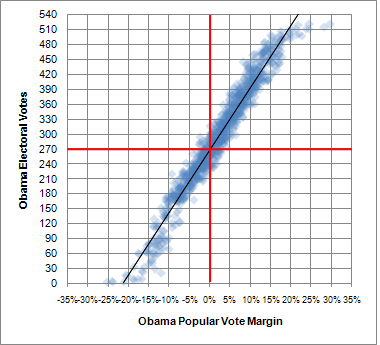
This might be my favorite graph that we've done so far: a comparison of Barack Obama's popular and electoral vote totals across the first 1,000 simulations that we ran last night:


Several interesting things to point out:

1. The relationship between the popular vote and the electoral vote is approximately linear, except at the endpoints. As a rule of thumb, a gain of one percentage point in a Obama's popular vote share results in a gain of 25 electoral votes. This is also, you will note, a pretty steep slope. If Obama wins the election by 4 percentage points, he projects to win by approximately 100 electoral votes (319-219). 

2. The regression line crosses the y-intercept at 269.3 electoral votes, which is almost exactly half of 538. That means that there does not appear to be any systematic advantage in the electoral vote math to one candidate or another, at least based on our present rendering of these numbers.

3. Where you do see a little bit of skew are those scenarios where one candidate wins by about 5-15 percentage points. In those cases, the winning candidate tends to win by more electoral votes than is predicted by the regression line. This is because an especially high number of states are within reach for one or another candidate. In contrast to 2004, when 16 states and the District of Columbia were decided by 20 or more points, very few are polling that way this year.

4. The range of possible outcomes given any specific value of the popular vote is about 80-100 electoral votes wide. For example, an Obama win by 5 percentage points could easily be associated with any number from about 290 electoral votes up to as many as 390, depending on how the individual states shake out. Likewise, for any given value of the electoral vote, the range of the popular vote margin is about 6 or 7 percentage points wide. What this means, among other things, is that it's virtually impossible for a candidate to win the electoral college while losing the popular vote by more than about 3 or 3.5 percentage points.

Poll: Obama Opens 14-Point Lead On McCain


Go to CBSNews.com Home


Poll: Obama Opens 14-Point Lead On McCain
Oct. 14, 2008

(CBS) Democratic presidential nominee Barack Obama is entering the third and final presidential debate Wednesday with a wide lead over Republican rival John McCain nationally, a new CBS News/New York Times poll shows. 

The Obama-Biden ticket now leads the McCain-Palin ticket 53 percent to 39 percent among likely voters, a 14-point margin. One week ago, prior to the Town Hall debate that uncommitted voters saw as a win for Obama, that margin was just three points.
 
Among independents who are likely voters - a group that has swung back and forth between McCain and Obama over the course of the campaign - the Democratic ticket now leads by 18 points. McCain led among independents last week. 

McCain's campaign strategy may be hurting hurt him: Twenty-one percent of voters say their opinion of the Republican has changed for the worse in the last few weeks. The top two reasons cited for the change of heart are McCain's attacks on Obama and his choice of Sarah Palin as running mate. 


Obama is widely seen as running the more positive campaign: Sixty-one percent of those surveyed say McCain is spending more time attacking his opponent than explaining what he would do as president. Just 27 percent say the same of Obama. 

McCain's favorable rating has fallen four points from last week, to 36 percent, and is now lower than his 41 percent unfavorable rating. Obama, by contrast, is now viewed favorably by half of registered voters and unfavorably by just 32 percent. 

Obama holds a considerable edge over his rival on having the right "personality and temperament" to be president, with 69 percent saying Obama does and 53 percent saying McCain does. The Democratic nominee is also widely seen as more likely to make the right decision on the economy, far and away the top issue for voters, in a survey taken in the immediate aftermath of last week's historic Wall Street losses. 

Opinions of the candidates could still change, and potential trouble spots remain for Obama, among them the fact that small percentages of voters cite Obama's past associations with Bill Ayers (9 percent) and Reverend Jeremiah Wright (11 percent) as issues that bother them. 

But with more than four out of five of each candidate’s supporters now saying their minds are made up, the poll suggests that McCain faces serious challenges as he looks to close the gap on his Democratic rival in the final three weeks of the campaign. 

Views Of The Candidates 

Obama's lead over McCain when it comes to the economy has grown since last week, and a majority of registered voters now say they are not confident in McCain to make the right decisions on economic issues. Thirty-nine percent are not confident in Obama. 

There is, however, an opening for the candidates in this area: Fewer than one quarter are presently very confident in either Obama or McCain to make the right decisions on the economic crisis. 

On raising taxes - an area where a Republican nominee might be expected to have an edge - Obama also leads. Despite the McCain campaign's efforts to cast Obama as a tax-raiser, more registered voters say McCain is likely to raise their taxes (51 percent) than say Obama will raise their taxes (46 percent). 

Voters are almost three times more likely to be very confident in Obama when it comes to health care (28 percent) than McCain (10 percent). A majority of voters, 54 percent, are not confident in McCain to handle health care, while 33 percent are not confident in Obama. 

McCain continues to be hurt by his perceived ties to the unpopular Republican president, George W. Bush, whose approval rating is 24 percent. More than half of registered voters surveyed say they expect McCain to continue Mr. Bush's economic policies if he is elected. 

Obama holds a more than 20-point edge when it comes to understanding voters' needs and problems, with 64 percent saying Obama does and 43 percent saying McCain does. 

The Republican nominee does hold a clear advantage on being seen as prepared to be president, as he has throughout the campaign. That measure does not appear to be boosting his support, however, perhaps because while 64 percent say McCain is prepared for the job, more than half say Obama is as well. 

Just 7 percent of registered voters say their opinion of McCain has improved recently, while 21 percent say it has gotten worse. The numbers are nearly reversed for Obama: Seventeen percent say their opinion of Obama has improved in recent weeks, while 7 percent say it has declined. 

Obama now enjoys leads over McCain with both men (53 percent to 41 percent) and women (52 percent to 37 percent). Eighty-two percent of voters who backed Hillary Clinton in the primaries now say they will back Obama - up from 67 percent last week and the highest number to date. 

McCain still leads among Republicans, conservatives and white evangelicals, but the race is now roughly even among whites, a group McCain led 54 percent to 39 percent last week. 

With voter registration up in many key states this year, 63 percent of those casting a ballot for first time in 2008 are backing Obama. 

The Debates And The Candidates' Past Associations 

Seven in 10 registered voters said they watched last week’s presidential debate, and, looking back, 57 percent of debate watchers said Obama won the contest. Just 18 percent saw the debate as a McCain victory. 

Expectations are high for Obama in Wednesday's third and final debate, which 65 percent of registered voters say they are very likely to watch. Nearly half of all registered voters expect Obama will win the debate, while just 19 percent expect McCain to win. 

Recently, the McCain campaign has gone after Obama about his relationship with former Weather Underground member Bill Ayers, and McCain has signaled that he will mention Ayers in the debate. 

One in three voters say they have heard "a lot" about Ayers, and 31 percent say they have heard something about him, though far fewer - 9 percent - say the association bothers them. 

Four percent of voters say that it bothers them that Obama is a Muslim, which he is not. Fifty-six percent say nothing about Obama’s past bothers them. 

As for the Republican candidate, seven in ten voters say nothing about McCain’s past bothers them. Four percent mention the Keating Five scandal that McCain was involved in the late 1980s and early 1990s. 

A majority of registered voters believe the tone of the 2008 campaign has been about the same as in past years. Thirty percent say it has been more negative, while 15 percent say it has been more positive. 

Democrats, Republicans, And The 2008 House Vote 

Americans have a much higher opinion of the Democratic Party than the Republican Party. A majority - 52 percent - have a favorable opinion of the Democrats, while far less - 37 percent - have a favorable opinion of Republicans. 

The Democratic Party is seen as more likely than the Republican Party to make the right decision on health care (55 percent to 18 percent), the economy (47 percent to 29 percent), and the war in Iraq (44 percent to 37 percent). 

And when it comes to the House Of Representatives, 48 percent of likely voters say they will be choosing the Democratic candidate in November, compared to 34 percent who plan to vote for the Republican candidate. 


This poll was conducted among a random sample of 1070 adults nationwide, including 972 registered voters, interviewed by telephone October 10-13, 2008. Phone numbers were dialed from RDD samples of both standard land-lines and cell phones. The error due to sampling for results based on the entire sample and the sample of registered voters could be plus or minus three percentage points. The error for subgroups is higher.


© MMVIII, CBS Interactive, Inc. All Rights Reserved.

Palin on her political future: 'That's a good question'

Posted: 06:23 PM ET

From
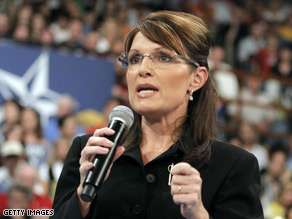
Sarah Palin discussed her political future Tuesday.

SCRANTON, Pennsylvania (CNN) – Though her cell phone service repeatedly dropped during her call-in, Sarah Palin made her first appearance on the Rush Limbaugh show on Tuesday, just minutes before taking the stage at a rally in Scranton.

Watch: Palin calls in to Limbaugh's show

In an unusual moment, Limbaugh asked Palin if she had thought about her "political future beyond this campaign." The vice presidential nominee told the conservative talker and his millions of listeners: “That’s a good question.” But she then quickly re-assured the radio host that her focus was on winning the White House with John McCain on November 4.

“No, because I am thinking about November 4, and I am just so absolutely passionate about the job that we have in front of us from now to November 4,” she said.

For the first time, Palin directly addressed the controversy surrounding ACORN’s voter registration operation, and suggested that the media is trying to cover up the story, despite the fact that dozens of national news outlets are investigating the community organization and Obama’s ties to the group.

“Let’s talk quickly about ACORN and the unconscionable situation that we are facing right now with voter fraud, given the ties between Obama and ACORN and the money his campaign has sent them,” Palin told Limbaugh. “Obama has a responsibility to reign in ACORN and prove that he is willing to fight voter fraud. For shame if the mainstream media were to cover this one up.”

RNC eyes $5M bailout for GOP senators

RNC eyes $5M bailout for GOP senators
By: Jonathan Martin 
October 14, 2008 11:08 AM EST

The Republican National Committee, growing nervous over the prospect of Democrats’ winning a filibuster-proof majority in the Senate, is considering tapping into a $5 million line of credit this week to aid an increasing number of vulnerable incumbents, top Republicans say.

With party strategists fearing a bloodbath at the polls, GOP officials are shifting to triage mode, determining who can be saved and where to best spend their money.

And with the House and Senate Republican campaign committees being drastically outspent by their Democratic counterparts, and outside groups such as Freedom’s Watch offering far less help than was once anticipated, Republicans are turning to the national party committee as a lender of last resort.

A decision is imminent because television time must be reserved and paid for upfront, and available slots are dwindling. 

A representative for the RNC would neither confirm nor deny that it was considering the move.

The RNC and National Republican Senatorial Committee are legally prohibited from discussing an “independent expenditure” campaign by the RNC for Senate races, including the content of the ads or where they run. Independent expenditure campaigns are run by a separate unit within the national committee, one “walled off” from the rest of the organization. But RNC strategists can deduce from the NRSC buys, as well as public polling, where their help is needed.

NRSC officials did not directly address the issue of an RNC-funded ad campaign for Senate races, but they said they had worked closely with their RNC counterparts throughout the cycle.

Both the NRSC and DSCC are allowed to spend limited funds directly on Senate races, but spend the bulk of their money on their own TV ad efforts in targeted states. During this cycle, the NRSC has spent heavily in Minnesota, North Carolina, New Hampshire and Mississippi, among other states.

GOP sources emphasized they would not be diverting money from John McCain, who they promised would continue to enjoy a steady stream of ads from the party’s independent expenditure arm. The party raised a record $66 million last month, and McCain is increasingly relying on RNC funds. “We’re not giving up on McCain,” said a top GOP source. “We’re still going to do everything we can there because his margin and what he does affects these races.” A senior Republican said: “We’re much better off having a competitive presidential ticket.”


But that the party would use new money to block a Democratic triumph in the Senate rather than boost the odds of its presidential nominee speaks volumes about what many Republicans think is still salvageable. And some in the GOP, especially those working on House and Senate races in which their candidates’ poll numbers swoon during the financial crisis, are increasingly agitated about money being spent on what all observers, including McCain, acknowledge is an uphill fight on top of the ticket.

“They should pull the money from McCain like [former RNC Chairman] Haley Barbour did in ’96, when Dole slid away, and funnel it to save some Senate and House seats as best they can,” said one longtime GOP strategist who is working on congressional races.

The RNC tried a similar “firewall” strategy late in the 2005-2006 election cycle, hoping to save GOP Senate seats in Ohio, Missouri and Tennessee. The RNC dumped millions of dollars into that effort only to see Democrats take two out of the three seats on their way to winning control of the Senate.

The RNC has also been running TV ads in several House districts, according to GOP and Democratic sources. Incumbents in both chambers who were previously seen as safe are now perceived as slipping away. But to ensure at least one bulwark against total Democratic control, GOP officials are more inclined to focus their resources on the Senate.

“There are seven or eight [seats in danger],” a top Republican said of the upper chamber. “What’s it going to be a week from now?” Party officials see GOP Senate seats at risk in North Carolina, Kentucky, New Hampshire, Colorado, Minnesota, Mississippi, Alaska, Oregon and Georgia.

The financial situation for Sen. Elizabeth Dole (R-N.C.) has gotten so precarious that she has announced she will be spending her own money on the campaign. Democratic third-party groups have spent millions attacking her as an ineffective senator, and her poll numbers have cratered.

According a source familiar with this week’s ad buys, the DSCC is outspending the NRSC by just under $30 million in targeted states. The committee has been using an e-mail appeal for a 60-seat, filibuster-proof majority to raise money, relying on such Democratic Party figures as former President Bill Clinton and Sens. Barack Obama, Joe Biden and Barbara Boxer.

But the Obama-Biden campaign has refused to provide millions of dollars in help to the DSCC, turning down a direct appeal by Majority Leader Harry Reid (D-Nev.) and arguing that it needs the money itself to beat McCain.

John Bresnahan and Josh Kraushaar contributed to this story.

© 2008 Capitol News Company, LLC

Worst Case Scenario (aka Blue Tsunami)

The Weekly Standard


Worst Case Scenario
What an Obama administration and a heavily Democratic Congress would accomplish.
by Fred Barnes
10/14/2008 12:00:00 AM


John McCain trails Barack Obama and shows no signs, at the moment anyway, of propelling himself into the lead. Democrats lead in eight Senate seats currently held by Republicans and are close in three others. In the House, Republicans once thought they'd lose only 5 to 10 seats. Now things look worse.

Thanks particularly to the month-long financial crisis, Republicans are in extremely poor shape with the election three weeks away. This means the worst case scenario is now a distinct possibility: a Democrat in the White House, a Democratic Senate with a filibuster-proof majority, and a Democratic House with a bolstered majority.

If this scenario unfolds, Washington would become a solidly liberal town again for the first time in decades. And the prospects of passing the liberal agenda--nearly all of it--would be bright. Enacting major parts of it would be even brighter. You can forget about bipartisanship.

Start with "card check." It would permit organized labor to unionize the private sector without winning a certification election by secret ballot. It's easy to get workers to sign cards saying they want a union, but it's hard to get them to vote that way when labor organizers aren't hounding them. Card check is labor's last hope for more dues-paying union members.

Unions simply aren't popular and neither is card check. But it passed the House last year, only to be blocked in the Senate by a Republican filibuster. In 2009, with Washington controlled by Democrats, it would sail through Congress and President Obama would sign it. After all, neither Obama nor congressional Democrats have bucked organized labor even once.

Then Democrats might go after a longstanding target of big labor, section 14(b) of the Taft-Hartley Act. It allows states to enact right-to-work laws, which bar workers from being forced to join a union. Twenty-two states have right-to-work laws.

The liberal scheme for killing conservative talk radio--the so-called fairness doctrine--would stand an excellent chance of becoming law. It would require radio stations to offer equal time, for free, to anyone seeking to reply to broadcasts featuring political opinion. To remain profitable, many stations would have to drop conservative talk shows, a major medium for communicating conservative ideas, rather than give up hours of free time. Obama has said he opposes the fairness doctrine. But would he veto it? Not likely.

Obama would nominate liberals to fill Supreme Court vacancies--no doubt about that--with the strong likelihood they'd be confirmed. As a senator, he voted against John Roberts and Sam Alito. And free trade agreements would become a thing of the past, given liberal and labor opposition.

What about Obama's health care plan? He's described it as step or two away from a single payer, government-run health system like Canada's. While expensive, its chances of passage would be quite good.

A bad economy, however, might keep Obama and his allies in Congress from passing his entire package of tax increases and his "cap and trade" proposal for curbing the emission of greenhouse gases. Obama has called for increasing the tax rate on capital gains, dividends, and the income of top earners, and raising the cap on payroll taxes. But tax hikes would worsen, not stimulate, a weak economy. So that might make Democrats balk--except they might not. For liberals, requiring the well-to-do to pay higher taxes is a matter of ideology.

So is cap and trade. It would drive up the cost of energy, another downer for the economy, but Democrats believe it's necessary to save the planet. Besides, the environmental lobby would demand cap and trade's enactment. And environmentalists have as tight a grip on Democrats as labor does. Obama has never crossed environmentalists.

As for foreign and national security policy, there'd be nothing stopping President Obama from doing what he wanted in a liberal-dominated Washington, including a quick troop exit from Iraq and presidential-level talks with anti-American dictators. Congress would go along. The media would cheer.

But who knows? Maybe McCain and Republicans will rally their forces and keep the worst from happening--the worst, that is, from a conservative standpoint. The campaign has changed direction twice in less than two months, first when McCain picked Sarah Palin as his running mate, then when the financial panic hit. There could be a third game changer.

If not, we face the liberal deluge.

Fred Barnes is executive editor of THE WEEKLY STANDARD.

© Copyright 2008, News Corporation, Weekly Standard, All Rights Reserved.

New service to stop loose lips from crashing cars (AP)


Posted on Mon Oct 13, 2008 5:07PM EDT

NEW YORK - When David Teater's 12-year-old son, Joe, was killed in 2004 by a driver who was talking on a cell phone, he tried to cut back on his own habit of driving and talking. It turned out to be very difficult.

"You have to remember to turn the phone off ... which you never remember to do. Or you have to ignore a ringing phone, which is incredibly hard," Teater said. "We've been conditioned our entire lives to answer ringing phones."

Teater became an advocate for curbing what he calls "driving while distracted," and now, he's part of a company with a technology that can help.

Aegis Mobility, a Canadian software company, announced Monday that it has developed software called DriveAssistT that will detect whether a cell phone is moving at car speeds. When that happens, the software will alert the cellular network, telling it to hold calls and text messages until the drive is over.

The software doesn't completely block incoming calls. Callers will hear a message saying the person they're calling appears to be driving. They can hit a button to leave an emergency voice mail, which is put through immediately.

Several states, including New York and California, have introduced laws against talking on a cell phone while driving, but they still allow the use of hands-free devices like Bluetooth headsets. However, studies have shown that hands-free devices may not help. It appears that it is the distraction of dialing or talking that is dangerous, rather than the act of taking a hand off the wheel.

A study by the National Highway Traffic Safety Administration in 2006 found that dialing or talking on the phone was the cause in 7 percent of crashes and near-crashes. For the study, drivers had onboard "black boxes" that recorded their actions.

Last year, 41,059 people died in traffic accidents.

Aegis' software will work on phones with Windows Mobile software, popular for "smart" phones, or Symbian software, used in phones from Nokia and Sony Ericsson. It uses the phone's Global Positioning System chip to detect motion, aided by the cell-tower signal. If the phone has a Wi-Fi antenna, that can be used as well, said Dave Hattey, Aegis' CEO.

To work, the software has to be supported by the cellular carrier. Aegis has no deals in place yet, but is in discussions with the big U.S. networks, said Teater, who is a vice president at Aegis. The company hopes to be able to announce early next year that the software is available through a carrier, probably for $10 to $20 per month for a family.

The software can be managed remotely through a Web site. For instance, parents will get alerts if their kids override the motion-sensing feature to indicate that they're riding in car rather than driving. A corporation that buys the software for their employees can do the same.

Unusually for the world of cell phone software, Aegis is bringing out DriveAssistT in partnership with an insurance company. Nationwide Mutual Insurance Co. said it plans to offer a discount of 3 percent to 10 percent on family policies for people who use DriveAssistT.

13.10.08

McCain-Bailing '08

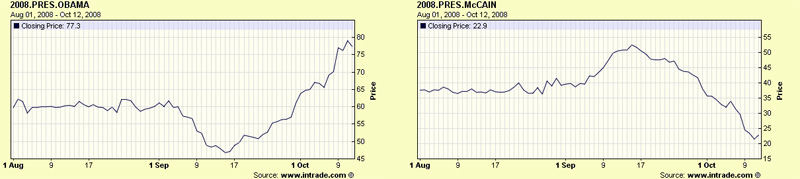
At the www.intrade.com betting site this morning you could buy 10 contracts on an Obama victory for $77.50 and 10 contracts on a McCain victory for $23.10. If you think McCain will win, you can recoup your stock market losses by selling all your stock today or tomorrow and putting all your money in McCain contracts. If he wins, you quadruple your money in just over 3 weeks. Here are the stock prices since Aug. 1, 2008. Note that the scales are different.

10.10.08

Stocks end worst week mixed after wild session


Stocks end worst week mixed after wild session

By TIM PARADIS, AP Business Writer16 minutes ago

Wall Street capped one of its worst weeks ever with a wild session Friday that saw the Dow Jones industrials gyrate within a 1,000 point range before closing with a relatively mild loss and the Nasdaq composite index actually ending with a modest advance. Investors were still agonizing over frozen credit markets, but seven days of massive losses and the possibility of further government support for the markets tempted some investors late in the session.

The Dow lost 128 points, giving the blue chips an eight-day loss of just under 2,400, or 22.1 percent. The average had its worst week on record in both point and percentage terms. The Standard & Poor's 500 index, the indicator most watched by market professionals, posted its worst weekly run since 1933.

The latest loss also means the Dow is down 40.3 percent since reaching a record high close of 14,164.53 a year ago, on Oct. 9, 2007. The S&P 500, which reached its high of 1,565.15 the same day, is down 42.5 percent.

Investors suffered a paper loss for the day of about $100 billion, as measured by the Dow Jones Wilshire 5000 index. For the week, investors lost $2.4 trillion, and over the past year, the losses have piled up to $8.4 trillion.

But there were signs Friday that some investors believe the market is near a bottom. On Thursday, selling accelerated in the last hour of trading. The Dow was down 221 points at 3 p.m. but closed down 679 points an hour later. On Friday, the Dow was down 468 points at 3 but rocketed 790 points and was up 322 points just after 3:30. It then sold off but closed down only 128.

And the Russell 2000 index, which tracks the movements of smaller company stocks, had a 4.66 percent gain Friday; small-cap stocks are often first on investors' shopping lists when they think a market turnaround is at hand.

"Nobody wants to miss the bottom," said Anton Schutz, president of Mendon Capital Advisors, who said of the Dow's performance, "I view it as a victory that we only finished down 100."

Some investors may have been placing bets ahead of the weekend meeting of officials from the Group of Seven nations, who gathered in Washington to discuss the economic meltdown. One of the potential remedies expected to be reviewed at the meeting is for governments to guarantee lending among banks.

"Everyone is hoping for really good news that can invigorate some buying and break this credit freeze, but your guess is as good as mine as to whether that will happen. I think people are desperate for action," said Jon Biele, head of capital markets at Cowen & Co. "It truly is remarkable to watch what's happening."

Still, Friday's widely mixed finish was proof that Wall Street still has a long list of troubles, and trading is likely to remain volatile when the market reopens on Monday.

"This kind of volatility in the market tells you that there are huge disagreements among investors about what the fundamentals are, about what the outlook is," said Ethan Harris, managing director and chief U.S. economist at Barclays PLC.

The hair-trigger mentality of the market — a reflection of the intense anxiety on the Street — was evident from the opening bell. The Dow fell 696 points in the first 15 minutes, recovered to gain more than 100 before that first hour was over and then turned sharply lower again. It spent much of the session with a deficit between 300 points and 500 points, regaining some ground and then falling again — until the last hour, when the average had swings spanning hundreds of points that took the Dow up as much as 322.

Investors have shuddered the past month over a credit market that remains frozen, posing a threat to the economy by making it harder and costlier for businesses and consumers to get a loan. But Friday's gainers included financial stocks, the ones most decimated by the credit crisis.

Harris said policymakers likely will continue to do what is needed to revive the credit markets. Actions taken so far by central banks, among them the Federal Reserve, have included increased lending and interest rate cuts.

"The deeper problem is not the stock market drop but the freezing up of the credit markets and that's the root problem and they have to keep applying the antifreeze until it works," Harris said.

The major indexes' sharp swings Friday were likely exacerbated by the computer-driven "buy" and "sell" orders that kicked in when prices fell far enough.

"Fear has been running rampant all over the Street. Fear and greed, that's what rules the Street. I think the carcass has been stripped to the bone," said Dave Henderson, a floor trader on the New York Stock Exchange for Raven Securities Corp. "The mood, it swings with the market. When we went positive, the euphoria down there was awesome. It's like at a football game."

The Dow fell 128.00, or 1.49 percent, to 8,451.49. At its low point Friday, the Dow was down 696.68 at 7,882.51, some 600 points above its low in Wall Street's last bear market, 7,286.27, reached Oct. 9, 2002. It crossed the line between gains and losses 32 times during the session.

Its close was the lowest since April 25, 2003.

Market index stats again told how horrific the run has been on Wall Street:

• The Dow lost 1,874.19 points, or 18.2 percent, during the week. Its dismal performance outdid the week that ended July 22, 1933, which saw a 17 percent drop — and back then, during the Great Depression, there were six trading days in a week.

• The Dow has fallen for eight straight sessions — the longest losing streak since the eight days of declines following the Sept. 11, 2001, terror attacks, when the blue chips lost 1,038.12, or 10.8 percent.

• It's been the worst run for the Dow since the nearly two-year bear market that ended in December 1974 when the Dow lost 45 percent.

• Since hitting their record highs a year ago, the Dow has lost 5,713 points, or 40.3 percent, while the S&P 500 is off 665.90 points, or 42.5 percent.

Beyond the Dow, broader stock indicators were mixed Friday.

The S&P 500 index fell 10.70 or 1.18 percent, to 899.22. The 18.2 percent drop for the week was the S&P's steepest decline since the week ending May 21, 1933; its worst loss was in 1929, when it fell 19.9 percent. The index lost 200.01 points for the week.

The Nasdaq composite index rose 4.39, or 0.27 percent, to 1,649.51. For the week, the Nasdaq lost 297.88, or 15.3 percent.

The Russell 2000 rose 23.28, or 4.66 percent, to 522.48. For the week, the Russell fell 96.92, or 15.64 percent.

Decliners led advancers 2-to-1 on the New York Stock Exhange, where consolidated volume came to a record 11.2 billion shares, compared with 8.14 billion traded Thursday.

Most major central banks around the world slashed interest rates this week after continuing problems in the credit market triggered concerns that banks will run out of money. Analysts have described the mood on trading floors this week as panicked at times, with investors bailing out of investments on fears there is no end in sight to the financial carnage.

A stream of selling forced exchanges in Austria, Russia and Indonesia to suspend trading, and those that remained opened were hammered. The rout in Australian markets caused traders there to call it "Black Friday."

European stocks sank Friday, with Britain's FTSE-100 falling 8.85 percent, German's DAX declining 7.01 percent, and France's CAC-40 ending down 7.73 percent. In Asia, the collapse of Japan's Yamato Life Insurance caused already nervous investors to pull even more money out of the market — the Nikkei 225 fell 9.6 percent.

An index considered to be Wall Street's fear gauge reached record highs on Friday in another sign of massive investor anxiety. The Chicago Board Options Exchange Volatility Index, known as the VIX, rose to an all-time intraday high of 76.94 Friday. The VIX, which usually trades under 50, tracks options activity for the companies that make up the S&P 500.

Still, prospects of further government help and, perhaps, attractive prices helped parts of the financial sector show signs of life. Big national banks were among the gainers, including Bank of America Corp., which rose $1.24, or 6.3 percent, to $20.87. Some smaller banks also rose, including Fifth Third Bank Corp., which advanced 67 cents, or 6.9 percent, to $10.40.

Not all financials enjoyed a bounce, however. Morgan Stanley Inc. fell $2.77, or 22 percent, to $9.68 as investors worried that even with a major investment from Japan's Mitsubishi UFJ Financial Group the company was still facing troubles. Meanwhile, Goldman Sachs Group Inc. fell $12.55, or 12 percent, to $88.80.

Financials were most prominent among the stocks that rose in the S&P 500, though technology stocks generally advanced. Apple Inc. rose $8.06, or 9.1 percent, to $96.80, while eBay Inc. rose 77 cents, or 4.8 percent, to $16.73.

Investors appeared unfazed by final results arriving in afternoon trading from an auction Friday that set the price of debt issued by now bankrupt Lehman Brothers Holdings Inc. at 8.625 cents on the dollar, down from a preliminary estimate of 9.75 cents.

The auction was for credit default swaps, which are contracts used to insure against the default of financial instruments like bonds and corporate debt. Traded in a $60 trillion, unregulated market, many of the instruments have fallen sharply because of their ties to bad mortgage debt. Those big losses and nervousness about who holds what CDS has made financial institutions hesitant to lend to one another. The auction could help the market determine which companies are most at risk from CDS losses.

___

AP Business Writers Joe Bel Bruno, Sara Lepro, Madlen Read and Dan Strumpf in New York contributed to this report.

___

On the Net:

New York Stock Exchange: http://www.nyse.com

Nasdaq Stock Market: http://www.nasdaq.com

Copyright © 2008 The Associated Press. All rights reserved. The information contained in the AP News report may not be published, broadcast, rewritten or redistributed without the prior written authority of The Associated Press. 

Copyright © 2008 Yahoo All rights reserved.Copyright/IP Policy |Terms of Service |Help |Feedback
NOTICE: We collect personal information on this site. To learn more about how we use your information, see our» Privacy Policy


Blog Archive

Search This Blog