3.1.08

Dollar fear sparks rush to oil and gold

By Javier Blas in London and Michael Mackenzie in New York
Published: January 2 2008 19:00

Crude oil prices briefly hit the $100-a-barrel mark and gold prices jumped to an all-time high as investors poured money into commodities on Wednesday amid deepening fears about the weakness of the US dollar.

The oil price rally soured the first stock trading day of the year, with the Dow Jones Industrial Average closing 1.7 per cent lower, its worst start since a slide of 1.9 per cent on the first day of trading in 1983.

The dollar fell against the euro and the yen after a report that showed the US manufacturing sector slumping to its lowest levels in five years during December. Investors bet that the Federal Reserve would be forced to lower interest rates in response to economic weakness, potentially increasing the downward pressure on the dollar.

The $100-a-barrel level was reached as the result of a single trade by two independent traders – known as locals – at the Nymex floor, industry sources said. Before the trade, oil prices were at $99.53 a barrel. In spite of the controversy about the single trade, crude oil closed up $3.64 at $99.62 a barrel in New York. The White House said President George W. Bush would not tap the Strategic Petroleum Reserve and was focused on other ways to boost US oil supplies.

The Institute for Supply Management said that its manufacturing index for December fell to 47.7, its lowest level since April 2003 and well below 50.8 in November. A reading below 50 indicates a contraction in activity and has historically served as a harbinger of recession. TJ Marta, fixed income strategist at RBC Capital Markets in New York, said: “A further decline in the overall index below 45 would be consistent with the recessions of 1990-91 and 2001.” Minutes from the Fed’s meeting in December, released Wednesday, revealed that policymakers “agreed on the need to remain exceptionally alert to economic and financial developments and their effects on the outlook”. The minutes said “members would be prepared to adjust the stance of monetary policy if prospects for economic growth or inflation were to worsen”.

Investors sought the safety of government bonds, sending the yield on the policy-sensitive two-year Treasury down to 2.88 per cent from 3.02 per cent. Interest rate futures fully priced in a quarter-percentage point rate cut to 4.0 per cent by the Fed by the end of this month.

The dollar fell to $1.4750 against the euro. Sterling also took a battering after weaker than expected purchasing managers’ data suggested the UK economy may also be facing a more severe slowdown than thought. The pound fell 1.3 per cent against the euro to a record low at £0.7447 and by 0.3 per cent against the dollar to $1.9791.

Gold was boosted by political tensions in Pakistan and the search by investors for hedges against inflation and further dollar weakness. Spot bullion prices in London hit a record $861.10 an ounce, above the previous peak of $850 an ounce reached in January 1980.

“People seem scared from a number of factors – an inflation spike, further US dollar weakness or systemic financial risk,” said John Reade, precious metals strategist at UBS in London.

Crude oil prices were also boosted by renewed tension in Nigeria, Africa’s biggest oil producer, and news that Chinese refineries are running at record levels to offset a gasoline shortage. The US data also put pressure on stocks in Europe, with the FTSE 100 off 0.5 per cent and the FTSEurofirst index falling 1.2 per cent.

Additional reporting by Neil Dennis in London
Copyright The Financial Times Limited 2008

(http://ft.com)

28.12.07

Pocketbook worries outweigh voters' concerns over war in Iraq

By JIM KUHNHENN and TREVOR TOMPSON, Associated Press Writers

WASHINGTON (AP) — Voters began to worry more about their pocketbooks over the last month — even more than about the war in Iraq.

More than half the voters in an ongoing survey for The Associated Press and Yahoo! News now say the economy and health care are extremely important to them personally. They fear they will face unexpected medical expenses, their homes will lose value or mortgage and credit card payments will overwhelm them.

Events, however, can quickly change public opinion. Thursday's assassination of Pakistan opposition leader Benazir Bhutto could draw more attention to terrorism and national security, an issue that still ranked highly with the public and which 45 percent of those polled considered extremely important.

This latest AP-Yahoo! News survey of more than 1,800 people by Knowledge Networks offers a unique opportunity to track changes in public attitudes as the presidential campaign unfolds. The first poll was last month and set a base line to measure national sentiment.

In the new results, men and women approaching retirement were especially attentive to the economy and health care, with six out of 10 ranking both issues extremely important. Politically, the attention to such domestic issues hangs darkly over Republicans. Voters say they are far more likely to trust Democrats to handle the economy and health care.

(http://news.yahoo.com)

Four cardinal principles of security violated, say Indian experts

Praveen Swami

New Delhi: While Pakistan’s Ambassador to the United States, Mahmud Ali Durrani, maintains that Pervez Musharraf’s government provided “unprecedented security” to Benazir Bhutto, Indian security experts disagree.

Speaking to The Hindu, a senior Special Protection Group official who reviewed available footage of the attack described Ms. Bhutto’s security as “dismal, almost as bad as if it was designed to facilitate her assassination.” Set up in the wake of Indira Gandhi’s assassination, the elite SPG provides security to both serving and past Indian Prime Ministers and their families.

The content of an e-mail sent in October 2007 by Ms Bhutto to an American confidant, Mark Siegel, who has been interviewed by CNN, was referred to the Indian experts. In the e-mail, she charged President Pervez Musharraf with failing to upgrade her security despite a near-successful assassination attempt. She complained that she had been “made to feel insecure by his minions and there is no way what is happening in terms of stopping me from taking private cars or using tinted windows or giving jammers or four police mobiles cld [could] happen without him.”

The SPG official is of the firm opinion that the upgrades might have saved Ms Bhutto’s life. According to him, four cardinal principles of security for high-risk targets were violated in the course of Ms. Bhutto’s campaign rally at the Liaquat Bagh in Rawalpindi:

Access-control protocols common among security services worldwide were violated. All those allowed close proximity with Ms Bhutto’s person, vehicles, or campaign podium should have been identified and screened long before her rally.

Long, medium and close-range security cordons should have been in place to ensure that all those close enough to launch an attack on Ms Bhutto had passed through at least three layers of physical frisking and metal-detector searches.

Technologies to prevent remote-controlled bomb detonation and detect concealed explosives should have been in place, even though these would not have deterred this particular attack. In addition, incognito guards should have been infiltrated into the crowd around Ms Bhutto to immediately interdict an attack. This might well have saved her life.

Ms Bhutto’s vehicle should have been shielded from the crowd by the presence of other escort cars, which would have rendered it more difficult for an attacker to find a suitable line of fire. This was indeed one of the complaints listed in her e-mail.

“We’ve repeatedly rehearsed scenarios similar to that played out in Rawalpindi,” the SPG official noted, “and have found that the elaborate systems we have in place to protect the Prime Minister of India are the sole means to defeat them. My assessment is that it is impossible for such an attack to have been prevented other than by a specialist security service.”

More likely than not, the SPG official noted, “the terrorist group that attacked Ms Bhutto had carried out several reconnaissance operations at past congregations. They would have noted that she often waved at crowds from her car’s sun-roof, and identified this as a weakness. However, Pakistan’s intelligence services should have warned her to end this habit, and also looked out for cells conducting reconnaissance.”

Another expert, an officer responsible for the security of a high-risk target in Jammu & Kashmir, noted that Indian politicians were routinely protected amidst large, unruly crowds – a factor some have said facilitated the successful terrorist attack on Ms Bhutto.

(http://www.hindu.com)

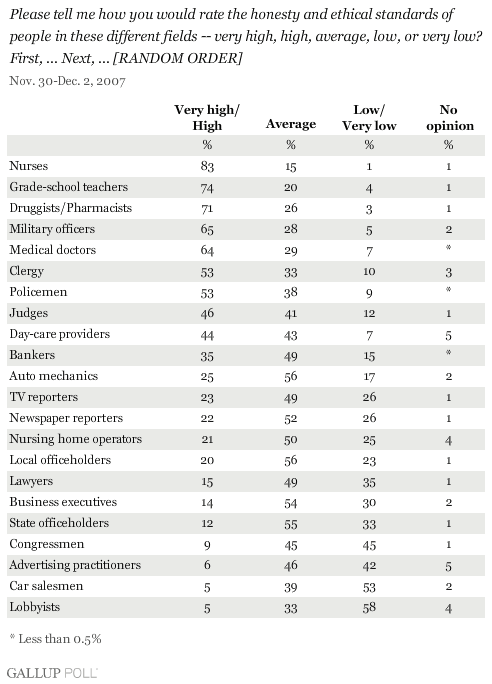
Lobbyists Debut at Bottom of Honesty and Ethics List

Dec 10, 2007

(http://www.gallip.com)

Blog Archive

Search This Blog