28.12.07

Pocketbook worries outweigh voters' concerns over war in Iraq

By JIM KUHNHENN and TREVOR TOMPSON, Associated Press Writers

WASHINGTON (AP) — Voters began to worry more about their pocketbooks over the last month — even more than about the war in Iraq.

More than half the voters in an ongoing survey for The Associated Press and Yahoo! News now say the economy and health care are extremely important to them personally. They fear they will face unexpected medical expenses, their homes will lose value or mortgage and credit card payments will overwhelm them.

Events, however, can quickly change public opinion. Thursday's assassination of Pakistan opposition leader Benazir Bhutto could draw more attention to terrorism and national security, an issue that still ranked highly with the public and which 45 percent of those polled considered extremely important.

This latest AP-Yahoo! News survey of more than 1,800 people by Knowledge Networks offers a unique opportunity to track changes in public attitudes as the presidential campaign unfolds. The first poll was last month and set a base line to measure national sentiment.

In the new results, men and women approaching retirement were especially attentive to the economy and health care, with six out of 10 ranking both issues extremely important. Politically, the attention to such domestic issues hangs darkly over Republicans. Voters say they are far more likely to trust Democrats to handle the economy and health care.

(http://news.yahoo.com)

Four cardinal principles of security violated, say Indian experts

Praveen Swami

New Delhi: While Pakistan’s Ambassador to the United States, Mahmud Ali Durrani, maintains that Pervez Musharraf’s government provided “unprecedented security” to Benazir Bhutto, Indian security experts disagree.

Speaking to The Hindu, a senior Special Protection Group official who reviewed available footage of the attack described Ms. Bhutto’s security as “dismal, almost as bad as if it was designed to facilitate her assassination.” Set up in the wake of Indira Gandhi’s assassination, the elite SPG provides security to both serving and past Indian Prime Ministers and their families.

The content of an e-mail sent in October 2007 by Ms Bhutto to an American confidant, Mark Siegel, who has been interviewed by CNN, was referred to the Indian experts. In the e-mail, she charged President Pervez Musharraf with failing to upgrade her security despite a near-successful assassination attempt. She complained that she had been “made to feel insecure by his minions and there is no way what is happening in terms of stopping me from taking private cars or using tinted windows or giving jammers or four police mobiles cld [could] happen without him.”

The SPG official is of the firm opinion that the upgrades might have saved Ms Bhutto’s life. According to him, four cardinal principles of security for high-risk targets were violated in the course of Ms. Bhutto’s campaign rally at the Liaquat Bagh in Rawalpindi:

Access-control protocols common among security services worldwide were violated. All those allowed close proximity with Ms Bhutto’s person, vehicles, or campaign podium should have been identified and screened long before her rally.

Long, medium and close-range security cordons should have been in place to ensure that all those close enough to launch an attack on Ms Bhutto had passed through at least three layers of physical frisking and metal-detector searches.

Technologies to prevent remote-controlled bomb detonation and detect concealed explosives should have been in place, even though these would not have deterred this particular attack. In addition, incognito guards should have been infiltrated into the crowd around Ms Bhutto to immediately interdict an attack. This might well have saved her life.

Ms Bhutto’s vehicle should have been shielded from the crowd by the presence of other escort cars, which would have rendered it more difficult for an attacker to find a suitable line of fire. This was indeed one of the complaints listed in her e-mail.

“We’ve repeatedly rehearsed scenarios similar to that played out in Rawalpindi,” the SPG official noted, “and have found that the elaborate systems we have in place to protect the Prime Minister of India are the sole means to defeat them. My assessment is that it is impossible for such an attack to have been prevented other than by a specialist security service.”

More likely than not, the SPG official noted, “the terrorist group that attacked Ms Bhutto had carried out several reconnaissance operations at past congregations. They would have noted that she often waved at crowds from her car’s sun-roof, and identified this as a weakness. However, Pakistan’s intelligence services should have warned her to end this habit, and also looked out for cells conducting reconnaissance.”

Another expert, an officer responsible for the security of a high-risk target in Jammu & Kashmir, noted that Indian politicians were routinely protected amidst large, unruly crowds – a factor some have said facilitated the successful terrorist attack on Ms Bhutto.

(http://www.hindu.com)

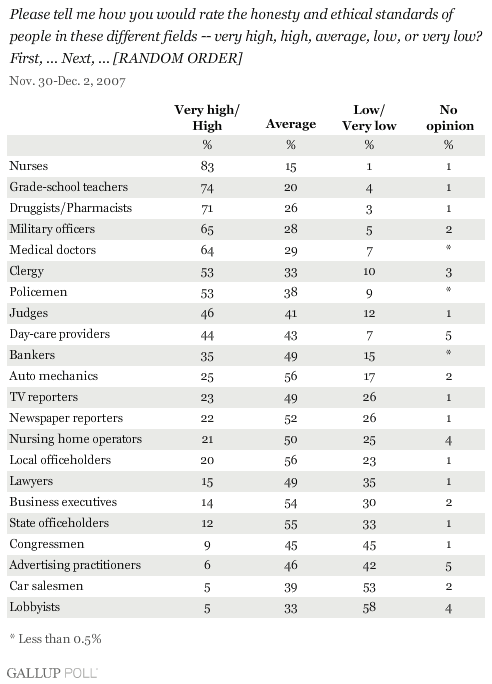
Lobbyists Debut at Bottom of Honesty and Ethics List

Dec 10, 2007

(http://www.gallip.com)

27.12.07

Dwindling dollar may be next US security threat

By Daniel Dombey

Published: December 27 2007 17:41 | Last updated: December 27 2007 17:41

At the end of a year in which the dollar has endured a marked decline against other currencies, an unsettling question is beginning to be voiced: can the troubles of the US currency be confined to the financial world or are they set to undermine Washington’s place on the international stage?

“This is the neglected dimension of the dollar’s decline,” says Flynt Leverett, a former senior National Security Council official under President George W. Bush. “What has been said about the fall of the dollar is almost all couched in economic terms. But currency politics is very, very powerful and is part of what has made the US a hegemon for so long, like Britain before it.”

Along with some other commentators, Mr Leverett brackets the dollar’s recent fragility with related phenomena, such as the greater international use of rival currencies. He argues that if such trends continue, the result will be costly for the US. While a lower dollar is associated with greater financing costs for America’s twin current account and budget deficits, he says, currency movements can be determined by politics as well as economics – and the US security could be damaged if America’s creditor nations move against the dollar.

“Americans will certainly find global hegemony a lot more expensive if the dollar falls off its perch,” adds Kenneth Rogoff, former chief economist of the International Monetary Fund, in an article published this month.

He maintains that the US has been fortunate to be able to use the huge low-interest dollar holdings of the central banks of China and Japan to finance higher return investments elsewhere, “but between the sub-prime US mortgage crisis and the dollar’s ongoing decline, America’s exorbitant privilege now looks a bit shaky . . . American voters, who are famously loath to increase taxes, might start thinking a lot harder about the real economic costs of their country’s superpower status.”

The tumble of the greenback – by more than 25 per cent against its trading partners since February 2002 when adjusted for inflation – may lead other nations to turn away from using dollars for their central bank reserves, international transactions or currency pegs, with expensive results for the US.

Indeed, central banks have begun to move in such a direction. China, which keeps the composition of its huge foreign exchange reserves a state secret, has hinted that it plans gradually to reduce the proportion held in dollars – some analysts put the current level at more than two-thirds. Yet while the dollar’s role as the most popular reserve currency is not under imminent threat, for cash it is a different story: last year, the value of euro notes in circulation overtook the value of circulating dollar notes.

“The US is extraordinarily fortunate in that its currency is also the international standard of value – if that would disappear, US leverage in many dimensions would also go,” says Benn Steil, director of international economics at the Council on Foreign Relations in New York. He highlights the US’s ability to further its influence by bailing other countries out of financial crises. “What countries need in a financial crisis is dollars and that gives the US enormous leverage.”

Mr Steil adds that the dollar’s all but indispensable role also gives Washington an important tool against countries such as Iran and North Korea, since by limiting their banks’ access to dollar financing – a step Washington has taken several times over the past year – the US can damage such countries’ financial systems and make financing more expensive to obtain.

Mr Leverett says the US could relatively soon become vulnerable to the kind of financial pressure that the strength of the dollar has allowed it to exercise in the past. In the classic example, Washington used the threat of a run on the pound to put pressure on the UK to withdraw troops from Egypt during the Suez crisis in 1956.

In future, that kind of leverage may belong to China. “Right now China wants to keep a close hold on how fast the renminbi appreciates,” he says. “But it’s increasingly likely that they decide their strategic interest to constrain the US at some point outweighs the economic considerations.”

Mr Leverett also points to what he says has been a series of unwritten but explicit understandings between the US and the oil producing countries of the Gulf that underpin the dollar’s role as the world’s leading currency by denominating oil contracts in dollars and linking local currencies to dollars in return for security guarantees.

Many economists play down such agreements – the dollar price of oil should not be affected by what currency it is priced in, determined as it is by supply and demand. But the way the US has pursued and cultivated such understandings for decades – Mr Leverett says from the 1940s on – highlights their significance for US policymakers.

“The arguments now on economic grounds are overwhelming that the Gulf Co-operation Council states, including Saudi Arabia, should drop the dollar peg” because of the currency’s decline, he says, alluding to many Gulf states’ worries that they are importing inflation because of the link to the low dollar. “Saudi officials will tell you it’s a strategic decision, not an economic one, that they are sticking with the dollar. That should be a real indicator to American policymakers and citizens that this is a real vulnerability.”

Indeed, at an Opec summit last month, Saudi Arabia headed off a push by Iran and Venezuela to price oil with reference to a basket of currencies rather than the dollar. In television footage apparently screened to reporters by mistake, Saud al-Faisal, Saudi Arabia’s foreign minister, argued that even mentioning the issue in the summit communiqué would weaken the dollar still further.

After the summit ended, Hugo Chávez, Venezuela’s president, declared that the “empire of the dollar is crashing”. Most economists and foreign policy analysts disagree, arguing that economic and foreign policy reasons mean that the dollar will maintain its pre-eminent role for the medium term. Many countries view the US Navy’s work in protecting oil flows out of the Gulf as a public good, providing a reason why the dollar-oil link is likely to persist.

Few economists expect a catastrophic collapse in the value of the dollar and many expect it to remain the world’s chief reserve currency for years to come.

But, challenging the consensus view, Menzie Chinn and Jeffrey Frankel of the US’s National Bureau of Economic Research argued in a research paper last year that, if the dollar’s decline continued, the euro could overtake it as the lead international reserve currency by 2022. Other economists have speculated that in the long term China will establish the renminbi as the dominant currency in Asia.

The effect of either scenario would not be confined to currency markets but could also have an impact on Washington’s spending patterns and financial clout – the nuts and bolts of 21st-century national security. The dollar might no longer be the source of the US’s power, but instead a factor in its decline.

Malaysia signs $16bn gas deal with Iran

By Najmeh Bozorgmehr in Tehran

Published: December 26 2007 20:50 | Last updated: December 26 2007 20:50

Iran has signed a $16bn gas contract with Malaysia, intensifying its efforts to shift its flow of oil and gas deals towards eastern countries and bypass US-led pressure to thwart investment by western companies.

The contract, signed on Wednesday between Iran’s Pars Oil and Gas Company and Malaysia’s SKS Ventures, owned by Malaysian billionaire Syed Mokhtar Al-Bukary, includes the $6bn development of the Golshan and Ferdows gas fields in the next five-and-a-half years.

The Iranian oil and gas sector is in dire need of foreign investment to help meet mounting domestic consumption and to preserve its production rates.

While the US government has put pressure on its western allies to halt investments in Iran because of suspicions over its nuclear programme, Iran, which has the world’s second largest oil and gas reserves, has openly pushed ahead with deals with Asian companies.

Wednesday’s agreement follows the signing of a $2bn oil contract with China’s Sinopec this month. ...

(http://www.ft.com)

25.12.07

You're only as good as Google says you are

You're only as good as Google says you are

Face it, you're going to get 'Googled'. Here's how to burnish your digital brand.

NEW YORK (Money Magazine) -- Who's Scott Burkett? A small-time actor; a family lawyer; a techie at the University of North Carolina. But if you Google "Scott Burkett," eight of the top 10 results, and most of the next 20, point to the 38-year-old chief executive of PlayMotion, a small video-game company. That's no coincidence. Over the past decade, video-game Scott has carefully nurtured his digital dossier. Why bother? "Everyone is going to see this stuff," says Burkett. "It's not just customers and investors who look you up. It's everyone."Including the person who may find you your next job.
According to ExecuNet, a career-networking company for executives, more than 80% of recruiters use Google to uncover information on candidates. While you can't completely control what appears under your name on search engines, it's not that hard to burnish your digital brand.
Start a Weblog Blogging can quickly shoot your name from obscurity to the top of search indexes, says Robyn Greenspan, senior editor at ExecuNet. Try to update it at least three times a week and use keywords that you think searchers are likely to look for. An aeronautical engineer might naturally use words like "aviation" and "altitude" in his blog, for example. Blogger.com is a commonly used (and free) place to get started. The site will guide you every step of the way. You'll also want to set up a social-networking profile.
Buy your domain Purchase your first and last name as a Web address. Even if you don't plan to set up a Web site now, it's a good idea to park it - GoDaddy.com will let you reserve a dotcom name for $9.99 a year. Don't let someone beat you to it. Buying on the secondary market can be expensive. If your name is common, try variations like "Firstname-Lastname.com" or your name followed by your profession.
Bury the bad stuff. If you've got a reasonably high profile in a competitive field or if you've ever jilted an employee, uncomplimentary words about you may find their way onto an industry message board or blog. The poster will use a pseudonym - but he or she will make sure that the reader knows who you are. Sweeping dirt to the second or third page of a Google search by buying your domain and blogging is usually enough. But if the stuff is really toxic, you can try having it removed. If contact information for a Webmaster isn't readily apparent on the site where you're being maligned, go to CheckDomain.com and search for the domain name. The search will spit back the e-mail address of the site's owner and may reveal a phone number and mailing address. Ask nicely. The site can't really be forced to do anything without getting lawyers involved, a costly and often ineffective strategy.

India's outsourcing industry takes toll on workforce

updated 4 hours, 49 minutes ago Story Highlights
Outsourced businesses employ more than 1.6 million Indians in their 20s and 30s
They typically make much more than their contemporaries They face sleep disorders, heart disease, depression and family discord, say experts Brewing crisis could undermine India's hugely profitable outsourcing industry

NEW DELHI, India (AP) -- The job came with a good salary, and good perks. Call center employees face sleep disorders, heart disease, depression and family discord, according to experts. But, 26-year-old Vaibhav Vats will tell you, it was doing him no good. His weight had grown to 265 pounds and he was missing out on social life as he worked long overnight hours at a call center. Eventually, he quit. "You are making nice money. But the tradeoff is also big," said Vats, who spent nearly two years at IBM Corp.'s call center arm in India, answering customer calls from the United States. Call centers and other outsourced businesses such as software writing, medical transcription and back-office work employ more than 1.6 million young men and women in India, mostly in their 20s and 30s, who make much more than their contemporaries in most other professions.

They are, however, facing sleep disorders, heart disease, depression and family discord, according to doctors and several industry surveys. Experts warn the brewing crisis could undermine the success of India's hugely profitable outsourcing industry that earns billions in dollars annually and has shaped much of the country's transformation into an emerging economic power.

Heart disease, strokes and diabetes cost India an estimated $9 billion in lost productivity in 2005. But the losses could grow to a staggering $200 billion over the next 10 years if corrective action is not taken quickly, said a study by New Delhi-based Indian Council for Research on International Economic Relations.

The outsourcing industry would be hardest hit, it warned. Reliable estimates on the number of people affected are hard to come by, but government officials and experts agree that it is a growing problem. Health Minister Anbumani Ramadoss wants to enforce a special health policy for employees in the information technology industry. "After working, they party for the rest of the time ... (They) have bad diet, excessive smoking and drinking," he said at a public meeting last month. "We don't want these young people to burn out."

The minister's comments have since infuriated the technology sector, which says it has been unfairly singled out for problems that also exist in other professions. The outsourcing industry has come under fire because the sedentary lifestyle ofits employees combined with often stressful working conditions makes them more vulnerable to heart disease, digestive problems and weight gain than others. Some complain of psychological distress.

Most call center jobs involve responding to phone calls through the night from customers in the United States and Europe -- some of whom can be angry and rude. It is monotonous and there is little meaningful personal interaction among co-workers. That can also be true of other jobs such as software writing and back-office work. "There are times when the stress is so overwhelming that they fail to cope with it. Then they come to us," said Archana Bisht who set up a counseling company, 1to1help.net, in Bangalore six years ago.

Her clientele has since grown to 25 companies -- seven of them were added in the past two months -- including such names as Intel Corp., IBM Corp., Hewlett Packard Co. and Mindtree Consulting Ltd. Each day, about 60 to 70 employees at these companies seek counseling from 1to1help.net. The complaints are many, but marital incompatibility and relationship issues top the list, Bisht said, often because the long, odd working hours means couples don't have much time together.

More women than men ask for help, she said. The outsourcing boom has created new employment opportunities for Indian women, but there has been little change in social expectations. Adding workplace demands to responsibilities at home, which often includes taking care of in-laws, leaves women workers with multiple stresses, Bisht said. Loneliness can also take a toll. "There is no social life," said Vats, who worked at night and either slept or watched television during these problems. The National Association of Software Services Companies, the main trade body of the outsourcing industry, said many of its member firms are already providing facilities like advice on health, gyms and money for regular checkups.

Companies like Infosys Technologies Ltd. have set up 24-hour help lines for counseling by psychologists, while others have tied up with companies like 1to1help.net. Some like HCL Technologies Ltd. have built daycare centers for children and routinely sponsor group outings by their employees. But the industry insists it would do nothing to impose any lifestyle on its employees. "We do not think it is for companies or for the government to interfere in the personal life of adult Indians," NASSCOM said in a statement. Also, there is little it can do to change the nighttime work hours of many outsourcing jobs. "The odd hours can play havoc with your health," said Vats. "I never got good sleep because everyone was up and getting ready to go to work when I got home ... Your diet goes for a toss. You get acidity, develop gastric problems."

Vats' weight has dropped to 214 pounds since leaving IBM Daksh two years ago. He's still overweight for his 5 feet 9 inch frame, but is much happier now working with a law firm for a much lower salary.

A recent survey by Dataquest magazine and technology consulting company IDC showed sleep disorders topped health complaints among outsourcing industry workers. About 32 percent of respondents complained of sleep disorders; 25 percent had digestive troubles; and 20 percent reported eyesight problems, said the survey, which covered 1,749 employees at 19 outsourcing companies. Yet, they would not talk about it openly. Several call center employees contacted by the Associated Press admitted to having many of these ailments, but they refused to be named or identify their employer. Sleep and digestive disorders, doctors say, can grow into bigger problems: hypertension, diabetes and heart disease.

Doctors say the rise in these diseases, alongside growing urbanization and fast-paced economic growth, is not surprising. But India's case is alarming because of the sheer number of people affected and the factors that make them vulnerable to these diseases, said Ravi Kasliwal, a cardiologist at New Delhi's Indraprastha Apollo Hospital. These include India's fat-rich diet, genetic factors make them highly vulnerable to diabetes, and abdominal obesity that gives rise to insulin resistance and heart disease.

"To top it all, there is lack of awareness," Kasliwal said. "One out of 10 persons aged 35 years or more in this country is prone to heart attack." Heart disease is projected to account for 35 percent of deaths among India's working age population between 2000 and 2030, Kasliwal said, citing a World Health Organization study. That number is about 12 percent for the United States, 22 percent for China and 25 percent for Russia.
"This is a very serious issue for this country," Kasliwal said. "But nobody wants to talk about.

(http://www.cnn.com/)

Blog Archive

Search This Blog