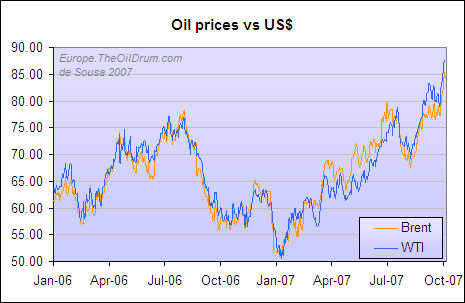
31.10.07

Oil prices in Euro

(http://europe.theoildrum.com)


Fed Rate Cut Could Help Send Oil Prices to $100

Fed Rate Cut Could Help Send Oil Prices to $100

By Jeff Cox | 31 Oct 2007 | 01:24 PM ET

Expectations that the Fed will cut interest rates, combined with an unexpected drop in crude supplies last week, could finally send oil prices over $100 a barrel.

The Fed is widely expected to approve a quarter-point cut in short-term borrowing rates this afternoon, a move that could further weaken the dollar and act as an enticement to buy oil.

Because oil is priced in dollars, a weaker U.S. currency makes oil cheaper for those in other countries to convert their currency and buy crude. That increased buying sends oil prices even higher.

In the meantime, a report on oil supplies showed crude stocks down 3.9 million barrels, news that stunned a market looking for an increase of 600,000 barrels.

It all adds up to more price pressure on oil

NYMEX CRUDE OIL FUTURES Front Month
US%40CL.1

94.19 3.81 +4.22%
BIS


[US@CL.1 94.19 3.81 (+4.22%) ], which surged to a record high of $93.80 on Monday and is just below that level today. Some analysts believe the $100 threshold is now well within sight of speculators who have been aggressively betting up oil prices.

"I think that's entirely possible," said Randy Ollenberger, managing director at BMO Capital Markets. The Fed rate cut "is going to lead to further weakness in the US dollar. There's obviously going to be a great correlation between oil prices moving higher and the dollar moving lower."

Analysts generally have oil fundamentals calling for a price between $75 to $80 a barrel.

But a rash of speculation driven primarily by geopolitical tensions has kept prices inflated. Javad Yarjani, an Iranian oil official with the Organization of Petroleum Exporting Countries, warned of an oil "bubble" that would pop.

Today's supply data, though, indicated that the oil rally could have more legs.

"Everybody wants to pick a number," said Mike Theesfeld, a trader with HPR Commodities.

"I wouldn't be surprised to see $95."
(http://www.cnbc.com)

Fed cuts rates to 4.5%

Citing turmoil in the housing market, Fed chair Ben Bernanke and Co. lower a key short-term rate by a quarter of a percentage point to keep the economy on track.
October 31 2007: 2:18 PM EDT

NEW YORK (CNNMoney.com) -- The Federal Reserve lowered the target for a critical short-term interest rate by a quarter of a point Wednesday, citing continued concerns about the housing market crunch.

The widely-expected move comes on the heels of a half-point rate cut by the central bank in September and leaves the federal funds rate at 4.5 percent, its lowest level since April 2001.

The federal funds rate, an overnight lending rate for banks, is important to the economy since it influences how much interest consumers pay on credit card debt, home equity lines of credit and auto loans. It also impacts how much it costs corporations to borrow money.

Weakness in the housing market and problems with subprime mortgages, loans made to those with less-than-perfect credit, have led to billions of dollars in writedowns at major financial institutions. For this reason, most investors believed the Fed would lower rates again in order to ensure that there is little spillover from the mortgage meltdown into the broader economy.

But some market observers have expressed concerns that with oil prices rising above $90, inflation may still be a threat. So the Fed could be making a mistake by lowering interest rates further, some maintain.

(http://money.cnn.com)

30.10.07

O'Neal walks with $161.4M

O'Neal walks with $161.4M
Merrill Lynch says the former executive will receive a package of stocks, options and retirement benefits as compensation.

NEW YORK (AP) -- Merrill Lynch's departing chief executive, Stan O'Neal, will walk away with $161.5 million in stock, options and retirement benefits, the company said Tuesday.

O'Neal left with a $131.4 million equity package of stock, options and restricted stock. His restricted stock and restricted stock units will continue to vest on their original schedules, the company said.

He also has retirement benefits worth $24.7 million, while his deferred compensation stands at $5.4 million, according to the company. He will be entitled to an office and an executive assistant for up to three years.

O'Neal's restricted stock and options holdings mean he could do even better if the stock rises under a new CEO, said James F. Reda, a compensation consultant. A $10 jump in the stock under new management could mean $30 million for O'Neal.

O'Neal, the second-highest paid Wall Street CEO in 2006, retired from Merrill Lynch & Co. on Tuesday, almost a week after the investment bank reported its largest-ever quarterly loss. The $2.24 billion loss was precipitated by a $7.9 billion third-quarter writedown, as the company revalued assets backed by shaky mortgages. O'Neal's ouster was expected after the loss.

There is some precedent for such an ironic windfall. After Michael Eisner was ousted as CEO at The Walt Disney Co. in 2005, he made another $100 million when the company's stock price improved under his replacement, Reda said.

"It's a funny dynamic," Reda said.

But Reda questioned both the size of O'Neal's package and why Merrill made O'Neal, 56, eligible for retirement even as he ran the company. The policy guaranteed O'Neal so much money that "he was basically indifferent," Reda said.

O'Neal's parting wealth comes after he spent five years as Merrill's (Charts, Fortune 500) CEO, earning nearly top dollar. O'Neal's 2006 pay was approximately $48 million, second on Wall Street only to the $54.3 million earned by Goldman Sachs Group Inc. CEO Lloyd C. Blankfein.

(http://money.cnn.com)

29.10.07

One-third of Americans are living with extreme stress

Thursday, October 25, 2007

One-third of Americans are living with extreme stress and nearly half of Americans (48 percent) believe that their stress has increased over the past five years, according to a survey released by the American Psychological Association.

The national survey also found that stress is taking a toll on people — contributing to health problems, poor relationships and lost productivity at work.

Money and work are the leading causes of stress for 75 percent of Americans, a dramatic increase over the 59 percent reporting the same sources of stress in 2006.

The Stress in America survey is part of APA's Mind/Body Health Public Education Campaign.

Fifty-one percent of Americans blame "the housing crisis" as a leading cause of stress, citing high rent or mortgage costs as sources of this stress.

(http://www.foxnews.com)

The French Lesson In Health Care

JULY 9, 2007

The French Lesson In Health Care
The nation's system isn't quite as superb as Sicko maintains, but it's pretty good

Michael Moore's documentary Sicko trumpets France as one of the most effective providers of universal health care. His conclusions and fist-in-your-gut approach may drive some Americans up the wall. But whatever you think of Moore, the French system—a complex mix of private and public financing—offers valuable lessons for would-be health-care reformers in the U.S.

In Sicko, Moore lumps France in with the socialized systems of Britain, Canada, and Cuba. In fact, the French system is similar enough to the U.S. model that reforms based on France's experience might work in America. The French can choose their doctors and see any specialist they want. Doctors in France, many of whom are self- employed, are free to prescribe any care they deem medically necessary. "The French approach suggests it is possible to solve the problem of financing universal coverage...[without] reorganizing the entire system," says Victor G. Rodwin, professor of health policy and management at New York University.

France also demonstrates that you can deliver stellar results with this mix of public and private financing. In a recent World Health Organization health-care ranking, France came in first, while the U.S. scored 37th, slightly better than Cuba and one notch above Slovenia. France's infant death rate is 3.9 per 1,000 live births, compared with 7 in the U.S., and average life expectancy is 79.4 years, two years more than in the U.S. The country has far more hospital beds and doctors per capita than America, and far lower rates of death from diabetes and heart disease. The difference in deaths from respiratory disease, an often preventable form of mortality, is particularly striking: 31.2 per 100,000 people in France, vs. 61.5 per 100,000 in the U.S.

That's not to say the French have solved all health-care riddles. Like every other nation, France is wrestling with runaway health-care inflation. That has led to some hefty tax hikes, and France is now considering U.S.-style health-maintenance organization tactics to rein in costs. Still, some 65% of French citizens express satisfaction with their system, compared with 40% of U.S. residents. And France spends just 10.7% of its gross domestic product on health care, while the U.S. lays out 16%, more than any other nation.

To grasp how the French system works, think about Medicare for the elderly in the U.S., then expand that to encompass the entire population. French medicine is based on a widely held value that the healthy should pay for care of the sick. Everyone has access to the same basic coverage through national insurance funds, to which every employer and employee contributes. The government picks up the tab for the unemployed who cannot gain coverage through a family member.

SAFETY NET
But the french system is much more generous to its entire population than the U.S. is to its seniors. Unlike with Medicare, there are no deductibles, just modest co- payments that are dismissed for the chronically ill. Additionally, almost all French buy supplemental insurance, similar to Medigap, which reduces their out-of-pocket costs and covers extra expenses such as private hospital rooms, eyeglasses, and dental care.

In France, the sicker you get, the less you pay. Chronic diseases, such as diabetes, and critical surgeries, such as a coronary bypass, are reimbursed at 100%. Cancer patients are treated free of charge. Patients suffering from colon cancer, for instance, can receive Genentech Inc.'s (DNA ) Avastin without charge. In the U.S., a patient may pay $48,000 a year.

France particularly excels in prenatal and early childhood care. Since 1945 the country has built a widespread network of thousands of health-care facilities, called Protection Maternelle et Infantile (PMI), to ensure that every mother and child in the country receives basic preventive care. Children are evaluated by a team of private-practice pediatricians, nurses, midwives, psychologists, and social workers. When parents fail to bring their children in for regular checkups, social workers are dispatched to the family home. Mothers even receive a financial incentive for attending their pre- and post-natal visits.

A typical PMI can be found in Goutte d'Or, a poor neighborhood at the foot of Montmartre that has been home for the past 20 years to a swelling population of immigrants from Africa and Southeast Asia. On Rue Cavé, a tidy modern building is given over entirely to caring for expecting mothers, infants, and young children. The place usually is bustling with kids scrambling over toys, while mothers, often immigrants in colorful headdresses and with babies strapped to their backs, talk to their doctors as part of twice-monthly evaluations.

PMI and other such programs are starting to get attention in U.S. health-care circles. "If we really want to ensure that no child is left behind, then the PMI system is a good way to do it," says Daniel J. Pedersen, president of the Buffett Early Childhood Fund. "It's based on the practical idea that high-quality investments made at the start of a child's life will pay huge dividends to both the child and society in the future."

To make all this affordable, France reimburses its doctors at a far lower rate than U.S. physicians would accept. However, French doctors don't have to pay back their crushing student loans because medical school is paid for by the state, and malpractice insurance premiums are a tiny fraction of the $55,000 a year and up that many U.S. doctors pay. That $55,000 equals the average yearly net income for French doctors, a third of what their American counterparts earn. Then again, the French government pays two-thirds of the social security tax for most French physicians—a tax that's typically 40% of income.

Specialists who have spent at least four years practicing in a hospital are free to charge what they want, and some charge upwards of $675 for a single consultation. But American-style compensation is rare. "There is an unspoken and undefined limit to what you can charge," says Dr. Paul Benfredj, a gastroenterologist in Paris.

Many French doctors, in fact, earn more by increasing their patient load, or by prescribing more diagnostic tests and procedures—a technique, also popular in the U.S., that inflates health-care costs. So far France has been able to hold down the burden on patients through a combination of price controls and increased government spending, but the latter effort has led to higher taxes for both employers and workers. In 1990, 7% of health-care expenditures were financed out of general revenue taxes, and the rest came from mandatory payroll taxes. By 2003, the general revenue figure had grown to 40%, and it's still not enough. The French national insurance system has been running constant deficits since 1985 and has ballooned to $13.5 billion.

That's why France is gearing up to make changes. It already requires patients to register with a general practitioner before visiting a specialist, or else agree to a lesser reimbursement, much like many U.S. insurance plans. But France isn't likely to make major changes to a system most citizens say they like. Why would they? Says Shanny Peer, policy director at the independent French-American Foundation: "France gets better results for less money and everyone is covered."

By Kerry Capell

(http://www.businessweek.com)

28.10.07

'Pak was preparing to use nuke missiles during Kargil war'

28 Oct 2007, 1008 hrs IST,PTI

LONDON: Pakistan was preparing to use nuclear missiles against India during the Kargil war, a new book has claimed, citing a conversation between US President Bill Clinton and Pakistan Prime Minister Nawaz Sharif eight years back.


"When President Clinton met Sharif at Blair House (in July 1999), Clinton asked Sharif if he knew how advanced the threat of nuclear war really was? Did he know, for example that his military was preparing to use nuclear missiles?" the book "Deception: Pakistan, the United States and the Global Nuclear Weapons Conspiracy" says.

Answering Clinton's query, Sharif shook his head implying he was unaware of his military's moves, investigative journalists Adrian Levy and Catherine Scott-Clark have claimed in their 586-page book.

Warning Sharif, the President said he had a statement ready for release that would pin all the blame for Kargil on Pakistan if the Prime Minister refused to pull his forces back.

Clinton further questioned Sharif on whether the Pakistani leader could be trusted on anything.

The US President reminded Sharif that despite his promise to help bring Osama bin Laden to justice, the ISI had continued to work with bin Laden and the Taliban to foment terrorism and the Americans knew that.

The Americans were unsure as to who was really in control in Islamabad, the authors said, as confusion prevailed over whether Sharif was in reality pushed into a war by General Pervez Musharraf, or he attempted to diminish his role in the crisis.

(http://www.timesofindia.com)

Fed tipped to deliver US rate cut

Last Updated: Sunday, 28 October 2007, 17:18 GMT

Up to two million US families could lose their home in the next year

The Federal Reserve is widely expected to cut US interest rates once again when it meets this week, analysts say.

A slew of recent concerns - including ongoing problems in the housing market and woes at Merrill Lynch - has underlined woes in the US.

The Fed cut interest rates in September from 5.25% to 4.75% as it tried to stimulate the flagging economy.

Analysts say a further reduction to at least 4.5%, or possibly even 4.25%, is likely on Wednesday.

The last rate decision was seen as sending a strong signal that the US authorities were prepared to intervene to stabilise the markets and to prevent the US economy sliding into recession.

If the Fed doesn't act decisively, the economy is at risk of calamity
Peter Morici, EconomisUniversity of Maryland

But some say that risk to the economy is still very real and that further action from the Fed is needed.

Others argue a rate cut would encourage reckless spending and promote a return to conditions that led to a boom-and-bust cycle in the property market.

There is also a risk of inflation becoming a greater problem if money is made cheaper to borrow, encouraging more consumer spending and takeover activity.

Sales of new and used homes are at record lows as lenders tighten up on who they will give mortgages to.

And up to two million US families - especially those with sub-prime mortgages - could eventually lose their homes as the credit crunch intensifies, a Congressional committee report said last week.

There is also nervousness in the markets, with uncertainty still lingering over how much exposure various big banks have to the credit crisis.

Last week Merrill Lynch reported $7.9bn (£3.85bn) in write-downs for the third financial quarter of the year - leading to its first loss since 2001.

The losses - which were much larger than it had initially forecast - were largely caused by exposure to bad mortgage-related debt.

We're not seeing the weakness in the US economy that would justify a big rate cut
Richard Kelly, Economist, TD Bank Financial Group

And one of the country's biggest mortgage lenders, Countrywide, said it was ready to refinance $16bn in loans after customers were unable to meet repayments.

University of Maryland economist Peter Morici said that the Fed needed to make another bold rates cut.

"Certainly a half-point cut would be in order in view of the revelations of Countrywide and Merrill," Mr Morici said.

"We cannot get the economy firing on all cylinders until the mortgage market reorganizes and that probably requires a low-interest environment for some time."

"If the Fed doesn't act decisively, the economy is at risk of calamity."

And Capital Economics analyst Julian Jessop said that a 50 basis point cut could not be ruled out.

"Two weeks ago it looked like they'd be able to keep rates on hold in December. Unfortunately, since then, the goalposts have moved".

Richard Kelly, an economist at TD Bank Financial Group, expects the rate to fall to 4.5% but argued that problems in housing should not be allowed to get out of perspective.

"We're not seeing the weakness in the US economy that would justify big rate cuts," Mr Kelly said.

"You won't see positive growth in residential investment until the end of 2008, but that only makes up 5% of the US economy.

"Exports are booming, and that's three times larger than the housing market."

(http://news.bbc.co.uk)

Clothes label (GAP) pulls items made in India


Clothes label pulls items made in India
29 Oct 2007, 0144 hrs IST

LONDON/NEW DELHI: International apparel major GAP said on Sunday that it was withdrawing garments sourced from India from its 3,000 stores following allegations of use of child labour by one of the company's vendors in the capital's Shahpur Jat area, possibly setting the stage for retaliation by the Indian government.


GAP's action followed an undercover investigation by a British newspaper purportedly showing the use of child labour to manufacture smocked blouses that were headed for shelves in the company's US and European stores ahead of Christmas.

The report said that children as young as 10 years old were working for a GAP sub-contractor and complained of working long hours, going unpaid and being subjected to threats and beatings.

A 10-year-old boy, filmed making clothes, told the British paper that he had been sold by his family to the factory owner. The boy was said to have been working for four months without pay and would not be allowed to leave the job until the fee his family received had been recovered.

The government reacted to the news cautiously with commerce minister Kamal Nath saying his officials would investigate the matter. Though he refrained from commenting on the case till "it has been thoroughly probed", the minister cautioned against the use of non-tariff barriers, like raking up the issue of child labour, as a protectionist device by the developed countries.

He warned of retaliation if investigations established that fresh trade barriers were being erected, as was found in Bangalore recently.

"I have already written to EU trade commissioner Peter Mandelson (on October 23) about non-tariff barriers being used as a protectionist device," Nath told TOI.

The hand-stitched tops, which were to be sold for around £20 in the Christmas season, are now being withdrawn. In response to the findings, GAP released a statement saying it was "unacceptable" for children to produce its clothing.

"It is clear that one of our vendors violated this agreement, and a full investigation is under way.... After learning of this situation, we immediately took steps to stop this work order and to prevent the product from ever being sold in our stores.

We are also convening a meeting of our suppliers where we will reinforce our prohibition on child labour," it said in a statement.


(http://www.timesofindia.com)

25.10.07

Oil hits new record over $90

Crude surges more than $3 after report suggests OPEC isn't likely to boost production and Middle East violence flares.

By Steve Hargreaves, CNNMoney.com staff writer
October 25 2007: 4:21 PM EDT

NEW YORK (CNNMoney.com) -- Oil prices hit a record high Thursday of more than $90 a barrel after reports indicated that the Organization of Petroleum Exporting Countries has no plans to increase production.

U.S. crude for December delivery jumped $3.36 to settle at $90.46 a barrel on the New York Mercantile Exchange, surpassing the previous settlement high of $89.47 a barrel set Oct. 19. Oil also hit a new trading peak of $90.60, breaking the previous record of 90.07, also set Oct. 19.

Oil had been higher throughout the day, but spiked late afternoon after comments from an OPEC official.

"We have no price band or price target," OPEC Secretary-General Abdalla Salem El-Badri said Thursday on the sidelines of a meeting with Chinese energy officials, according to an online report from the Wall Street Journal. "If it persists for a longer period, then we start worrying. But at this time we don't know what's going to happen next month."

El-Badri also said the cartel isn't having any discussions about increasing production, the Journal reported.

Think oil can't go higher? Think again

OPEC, which supplies about 40 percent of the world's 84 million-barrel-a-day oil habit, agreed to boost production by 500,000 barrels in September, but the move did little to calm oil prices.

There had been speculation that the cartel would again boost production at its next meeting in December.

One trader downplayed the notion that OPEC would increase production.

"No one has any more to give us," said Nauman Barakat, a trader at Macquarie Futures, the trading arm of Macquarie investment bank.

While Saudi Arabia is generally believed to have the ability to pump about 2 million more barrels a day - the world's only significant remaining spare production capacity - Barakat said they are keeping that in reserve in case of a real supply disruption.

Turkish attacks on Kurdish separatists in northern Iraq and reports of Lebanon firing on Israeli warplanes also pushed prices higher, as traders feared conflicts could spread to the broader Middle East.

In addition, Barakat believes that today's news revealing signs of a weak economy - including a fall in durable goods and slow housing sales - makes it nearly certain the Federal Reserve will cut interest rates next week, pushing the dollar lower and commodity prices higher.


"I think $90 is a rest stop," said Barakat, who added that traders have placed more bets that oil will hit $100 than they had on $90.

The good news for drivers is that the record crude prices so far haven't appeared to influence gasoline prices.

While crude has surged nearly 30 percent in the last month, the retail cost of gasoline has barely moved, going from a national average of $2.81 a gallon in September to $2.82 this month, according to the motorist organization AAA.

Experts say weak demand is to blame, as the summer driving season is over and it appears Americans are beginning to drive less anyway with gasoline near $3 a gallon.

Crude oil prices have more than quadrupled since 2002. Analysts say surging global demand combined with limited new supply is the main underlying factor.

The surge in prices has also attracted lots of speculative investment money, further driving prices higher. And the tight supply and demand situation magnifies the effect that geopolitical tensions have on prices, as there is less spare supply available globally to cover a disruption from places like Iran, Nigeria or Venezuela.

The falling U.S. dollar has also played a role, as oil worldwide is priced in dollars.

Oil producing nations have less incentive to ramp up output if the buying power they receive per barrel is declining, and foreign consumers have less incentive to reduce demand if oil is, relatively, getting cheaper for them.

(http://money.cnn.com)

Blog Archive

Search This Blog